
DEVELOPING A DATA-DRIVEN METHOD FOR YACHT DIMENSION PREDICTION
DOI:
https://doi.org/10.30649/ijmea.v3i1.399Keywords:
Yacht, regression, polynomial trendline, linear regression, power trendlineAbstract
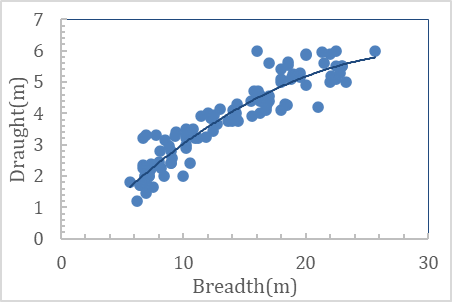
A yacht's principal dimensions can be found in many ways. However, due to the massive technological advancements in the yacht industry, using these ancient methods is just a waste of time. A new statistical method is necessary to determine yacht dimensions in an easy and effective way. In this paper, 122 modern yacht data have been used to investigate the relationship between length, breadth, draught, speed, gross tonnage, and power, and to perform regression analysis to develop a new method for estimating yacht dimensions. This study developed two predictive models: Model 1 utilizes empirical ratios and trendline equations, while Model 2 employs sequential stepwise multiple regression. The models effectively estimate breadth, draft, gross tonnage (GT), speed, and power from a specified length, with geometric parameters (e.g., GT prediction R²=0.97 in Model 1) showing higher reliability than performance parameters. The minimum and maximum ratio of Length to Breadth, draught to breadth, for a different range of ship length is also determined. This research is conducted in such a way that the owner’s requirement for a new yacht is the length, and other particulars are determined accordingly.
Downloads
References
D. Boote et al., “ISSC 2012 Committee V.8 YACHT DESIGN,” Oct. 2015, doi: https://doi.org/10.13140/rg.2.1.3985.7366
F. Mauro et al., “The effect of main dimensions on the preliminary design of motor yachts,” International Marine Design Conference, May 2024, doi: https://doi.org/10.59490/imdc.2024.904
T. Cepowski, “An estimation of motor yacht light displacement based on design parameters using computational intelligence techniques,” Ocean Engineering, vol. 231, p. 109086, Jul. 2021, doi: https://doi.org/10.1016/j.oceaneng.2021.109086
H. Karna, M. Braović, A. Gudelj, and K. Buličić,
“Artificial intelligence-based prediction model for maritime vessel type identification,”
Information, vol. 16, no. 5, Art. no. 367, Apr. 2025,
doi: 10.3390/info16050367.
Y. Yang et al., “Research on ship resistance prediction using machine learning with different samples,” *Journal of Marine Science and Engineering*, vol. 12, no. 4, Art. no. 556, Mar. 2024, doi: 10.3390/jmse12040556.
A. D. Papanikolaou, *Risk-Based Ship Design: Methods, Tools and Applications*. Berlin, Germany: Springer, 2009.
O. F. Hughes, F. Mistree, and V. Žanić, “A practical method for the rational design of ship structures,” *Journal of Ship Research*, vol. 24, no. 2, pp. 101–113, Jun. 1980,
doi: 10.5957/jsr.1980.24.2.101.
M. Mittendorf, Data-driven prediction of added resistance on ships in waves, Ph.D. dissertation, Dept. of Civil and Mechanical Engineering, Technical University of Denmark, 2023.
P. D. Kaklis, K. Kostas, and S. Khan, “Machine learning and modeling for ship design,” *Journal of Marine Science and Engineering*, vol. 13, no. 12, Art. no. 2304, Dec. 2025, doi: 10.3390/jmse13122304.
“SuperYacht Times,” *SuperYacht Times*, Nov. 28, 2019. [Online]. Available: https://www.superyachttimes.com/. [Accessed: Jan. 09, 2026].
Downloads
Published
How to Cite
Issue
Section
License
Copyright (c) 2026 International Journal of Marine Engineering and Applications

This work is licensed under a Creative Commons Attribution-NonCommercial-ShareAlike 4.0 International License.







