ANALYSIS OF PROCESS TIME AND COPPER SLAG REQUIREMENTS IN THE SHIP HULL BLASTING PROCESS
DOI:
https://doi.org/10.30649/ijmea.v3i1.400Keywords:
blasting, copper slag, waktu proses blasting, berat kebutuhan material abrasif, ISO 8501-1 SA 1/2Abstract
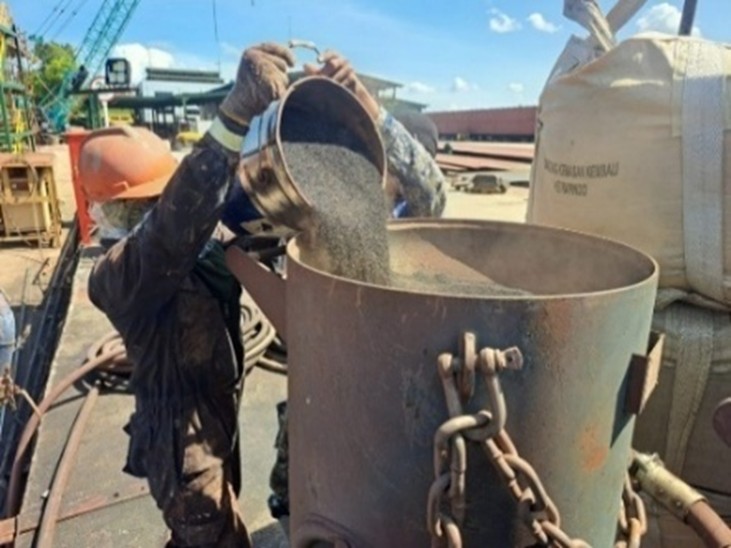
The blasting process in the shipping industry aims to clean the surface of the plate from dirt, rust, and mill scale, and provide surface roughness so that the paint layer can adhere well. In the blasting process, abrasive materials are often used once or twice, but in field practice, reused copper slag has been used as an abrasive material. This study aims to analyze the weight of abrasive material requirements and process time during the blasting process using the Analysis of Variance (ANOVA) method with variations in new copper slag use, reused copper slag 1 and 2 as abrasive materials reaching the standard cleanliness level of SA 2.5 and the surface roughness level according to the International Maritime Organization (IMO) Performance Standard for Protective Coatings (PSPC) 30 – 75 mikron and the International Organization for Standardization (ISO) 8501-1. The results of this study indicate that fresh copper slag and reused copper slag-1 exhibit lower effectiveness in the blasting process; both types of copper slag require a longer time to reach the SA 2.5 cleanliness standard, resulting in increased abrasive material requirements. On the other hand, reused copper slag-2 exhibits better performance with shorter blasting time and minimal abrasive material requirements in accordance with the ISO 8501-1 SA 2.5 cleanliness level.
Downloads
References
A. Sharma and V. Singh, “Adhesion evaluation of polymer-based composite coatings on carbon steel with the addition of different thickness intermediate adhesive layers,” Progress in Organic Coatings, vol. 140, p. 105500, 2020
Andi, H., L & Apriliani, R (2020). Sandblasting Pada Kapal MV Berlian Indah. Jurnal Saintara
Benkovsky, D & T, Swiatecki (1966). Technology of Ship Repairing. Moscow : MIR Publisher
Biro Klasifikasi Indonesia. (2013). Guidance For Coating Performance Standards, Vol G : Biro Klasifikasi Indonesia (BKI). Jakarta.
C. Wang and D. Li, “Adhesion improvement of ceramic coatings on carbon steel through the use of metallic interlayers with varying thickness,” Journal of the European Ceramic Society, vol. 39, no. 12, pp. 3700–3708, 2019.
Carolus Trijatmiko, Herman Pratikno dan Agung Purniawan. (2026). Analisa Pengaruh Material Abrasif Pada Blasting Terhadap Kekuatan Lekat Cat dan Ketahanan Korosi di Lingkungan Air Laut. Jurusan Teknik Kelautan. Institut Teknologi Sepuluh Nopember (ITS)
D. Lee, S. Kim, and Y. Choi, “Synthesis and characterization of interlayers for adhesion improvement of diamond-like carbon (DLC) coatings on carbon steel,” Surface and Coatings Technology, vol. 381, p. 125139, 2020.
Dale Stephenson, Terry M. Spear & Marie Seymour (2002). Characterization of the Aerosol Generated During Abrasive Blasting with Copper Slag, Montana Tech of The University of Montana. USA
Denny, D., & Ashari, L., M. (2018). Studi Komparasi Kelayakan Teknis Pemanfaatn Limbah B3 Sandblasting Terhadap Limbah B3 Sandblasting Dan Fly Ash Sebagai Campuran Beton, Juornal Technology Environmental Technology. Sanitary Engineering
Febby Hamzah Rosyadi. (2017). Effect Pressure and Grain Size Silica Sand in Blasting Process to Corrosion Rate ASTM A36 steel Department of Mechanical Engineering. University of Brawijaya
GritSablare Sustainable Solutions for Blasting & Cleaning. (2012). 10 Eliza Zamfirescu Leonida Street Bucharest. Romania
H. Zhang, W. Liu, and J. Sun, “Numerical modeling of the effect of interlayer thickness on residual stress and adhesion in three-layer coating systems,” Computational Materials Science, vol. 172, p. 109395, 2020.
Hudson, R. (1982). Surface Preparation for Coating. The National Physical Labotary
ISO 11126-3. (2018). Preparation of Steel Substrates Before Application of Paints and Related Products. Specifications for Non-metallic Blast-cleaning Abrasives,
ISO 11127-7. (2022). Preparation of Steel Substrates Before Application of Paints and Related Products. Test Methods for Non-metallic Blast-cleaning Abrasives
ISO 8501-1. (2011). Corrosion Protection of Steel Structures by Painting. International Organization for Standardization
K. Kambham, S. Sangameswaran, S. R. Datar, dan B. Kura. (2005). Copper slag Optimization of productivity and consumption for cleaner production in dry abrasive blasting. Journal of Cleaner Production
Liza & Salawati. (2017). Silikosis. JKS Jurnal Kedokteran Syiah Kuala
Novi Anggiat Lasma & Tri Agung Kristiyono. (2023). Experimental Study on The Effect of Epoxy Zinc and Thinner Ratio on Platform Structure Coating Quality. Hang Tuah University
Perkasa, R.E, Gunawan, L, Santosa, S.P dan Afdhal. (2023). A. Mechanical Anisotropy of Cold-Rolled St-37 Steel Plate Under High Strain Rates Loadings. Int. J. Mech. Eng. Technol.
Qi, C. Weinell, C. E., Dam-Johansen, K., & Wu, H. (2021). A Review of Blasting Waste Generation and Management in The Ship Repair Industry. Journal of Environmental Management
Suwasono, B. Putra, I.,K.,A.,S., Kristiyono, T.,A., & Azhar, A. (2021). Adhesive Coating Value Based on The Main Ingridient Of Ship Paint. Professional
Tri Agung Kristiyono, Soemarno, Marjono, Aminudin Afandhi & Dwisetiono. (2025). Environmental Risks Due to Sand Blasting Dust in Dock and Shipyard Areas Based on Particulate Matter Value. International Journal on Engineering Applications
Downloads
Published
How to Cite
Issue
Section
License
Copyright (c) 2026 International Journal of Marine Engineering and Applications

This work is licensed under a Creative Commons Attribution-NonCommercial-ShareAlike 4.0 International License.